The Bluehat Pre-College AI Scholars Program
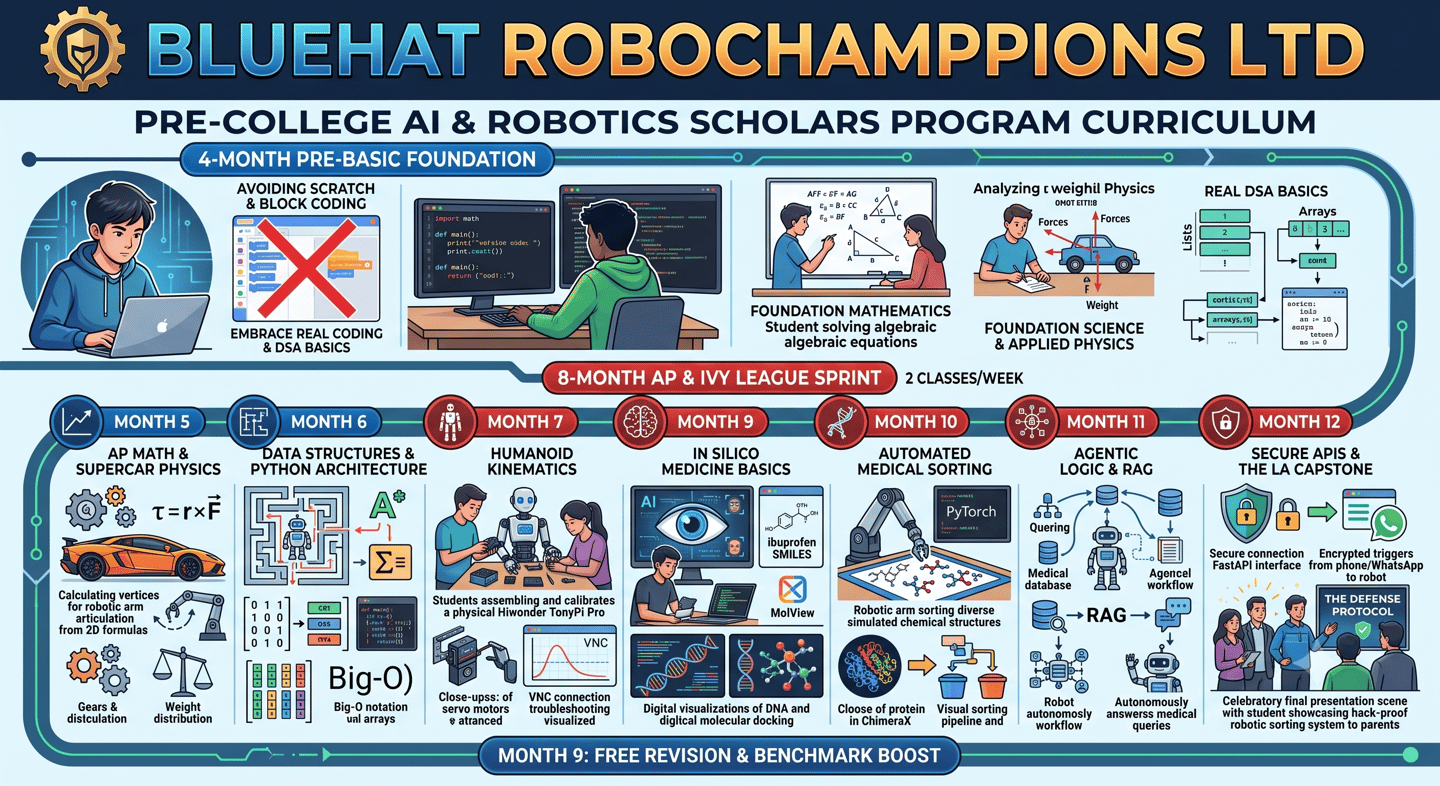
An 4 month Pre Basic Course +8-Month Applied Robotics & AP Tech Accelerator + one month Free revision & test module = 13 month programme
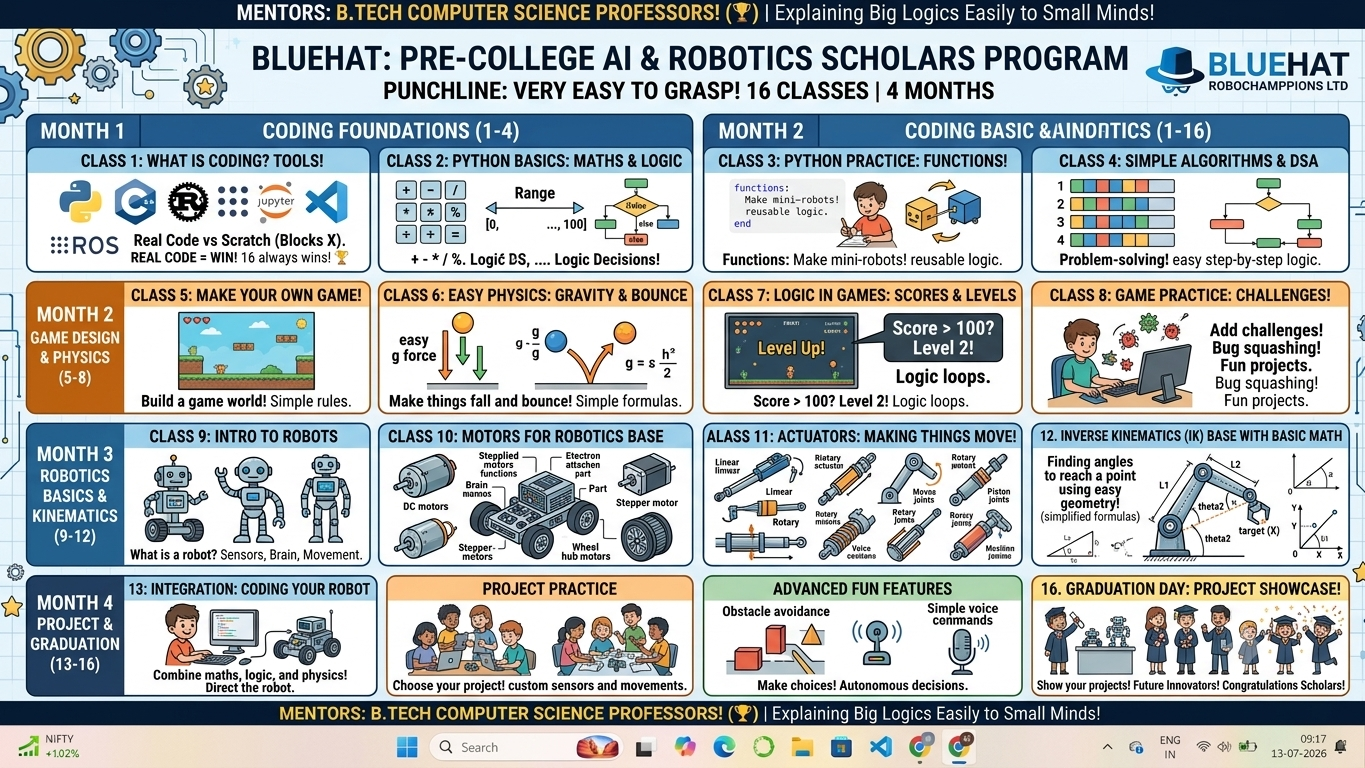
OPTION A 16 CLASSES
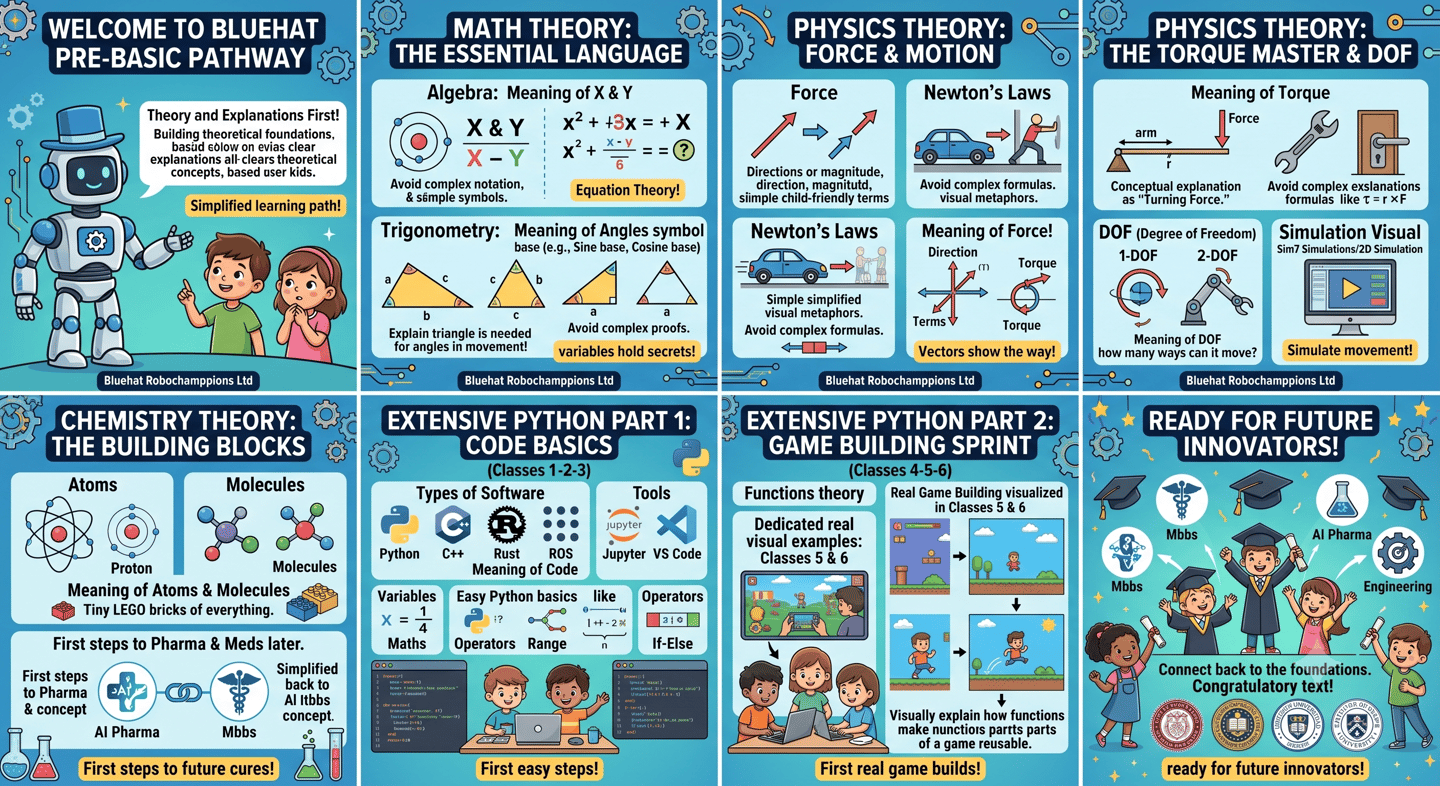
Choose Any one PRE BASIC COURSE
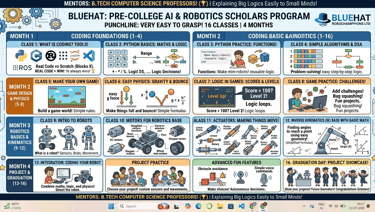
OPTION B for pre basics
You didn’t come this far to stop


Authorised payment gateway
please scan or upi & share screen shot
OUR PRIDE
TRUE VISIONARY CEO BTECH AI IITJ
31 YEARS EXPERIENCED IN TEACHING HEAVY SUBJECTS LIKE IIT , SAT AP ,AGENTIC AI , LLM BUILDING QULIFIED IITian & DECORATED WITH AI ENGG FROM IBM & MICROSOFT BADGE
CEO BLUEHAT SIRIN CHANGLANI
CORDINATOR ARTIFICIAL INTELLIGENCE CLUB IIT J EXPERT IN RAGS ,COMPUTER VISION , AGENTIC AI CREATION & DEPLOYMENT , INTERNATIONAL FINANCE TRAINED AT BANK OF NEW YORK
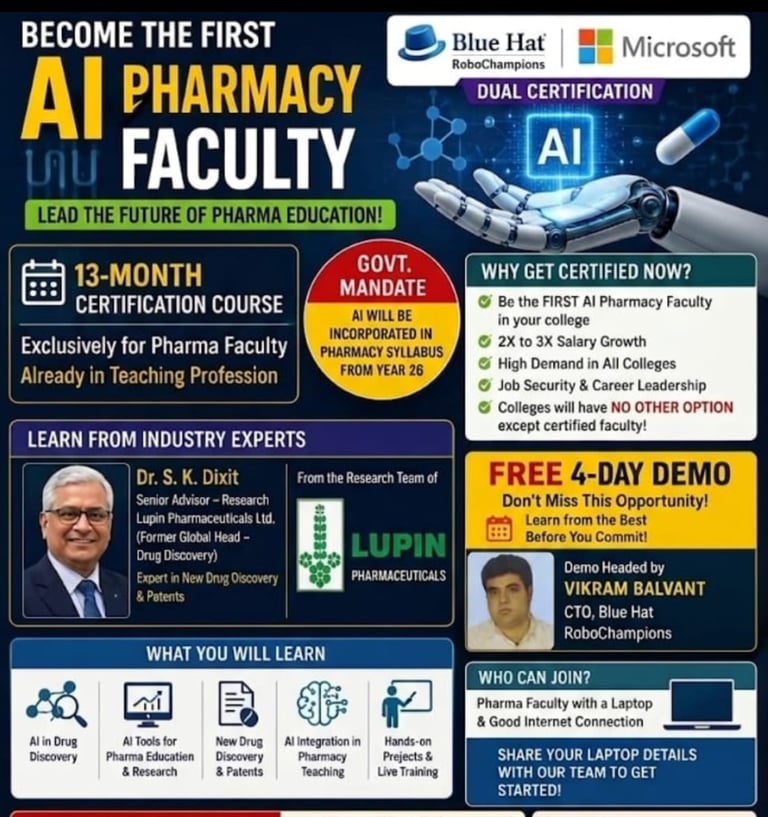
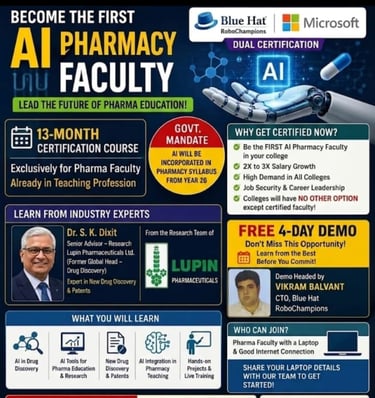
CHEIF OF AI PHARMACY


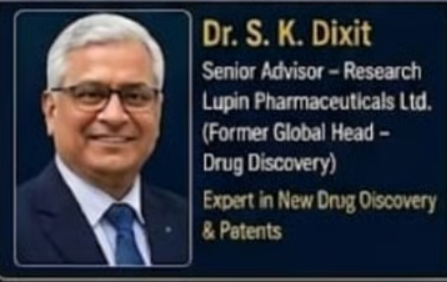

WE TAKE YOUR SMALL KIDS FUTURE VERY SERIOUSLY SO TEAM BLUEHAT IS FULLY QULIFIED IITians FULL TIME EMPLOYEES TO TAKE YR KIDS TO IV LEAGUE & AP WITHOUT STRESS
we have custom built speed program
WANT SLOW WE TAKE MORE CLASSES
WANT FASTER WE DECREASE CLASSES OR
INCREASE DEPTH AS IT SUITS YOUR CHILD
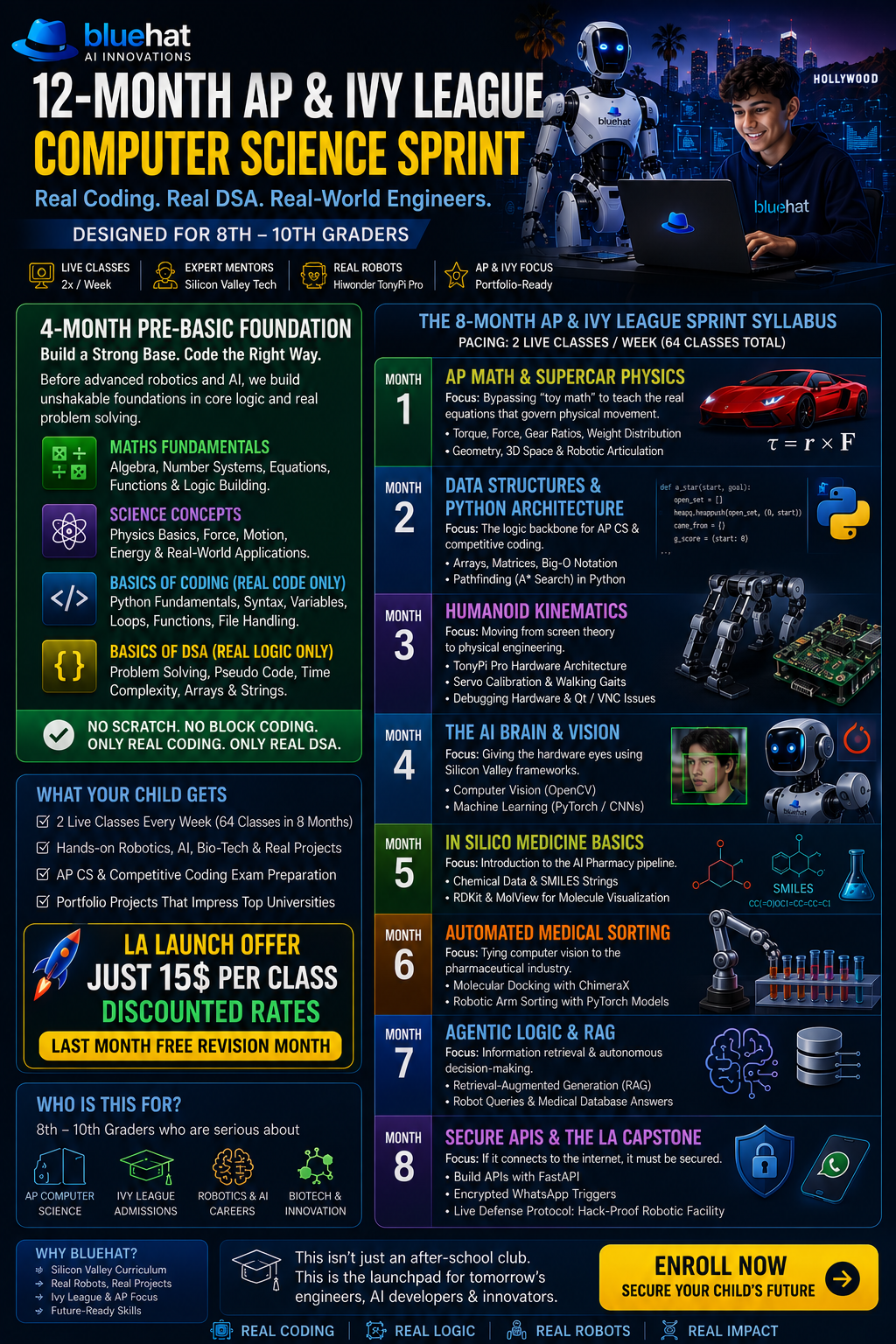
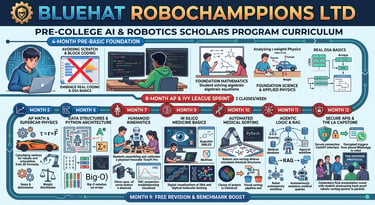
AFTER COMPLETING 4MONTH PRE FOUNDATION LETS DIVE INTO FURTHER 8 MONTHS COURSE FOR GRADES 8 TO 10TH OR AGE 13 TO 16 THEN 1 MONTH FREE REVISION FOR AP& IVY LEAGUE +TESTS

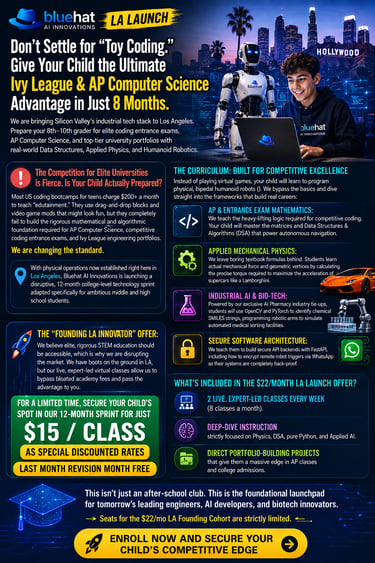
Our mission
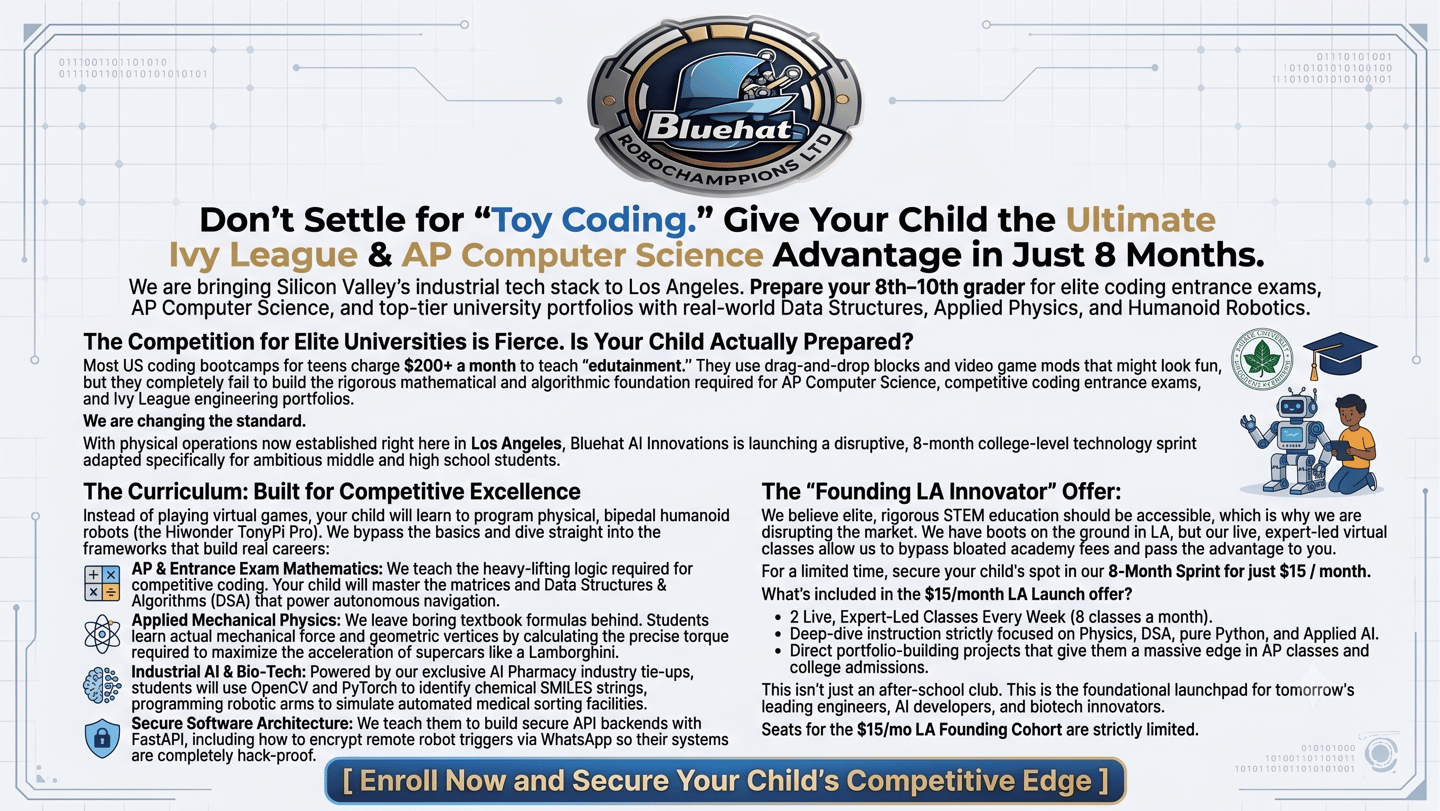
To transform your child into an Ivy League-caliber AI and robotics innovator.
Our vision
To democratize industrial-grade tech education, launching the next generation of Silicon Valley founders.
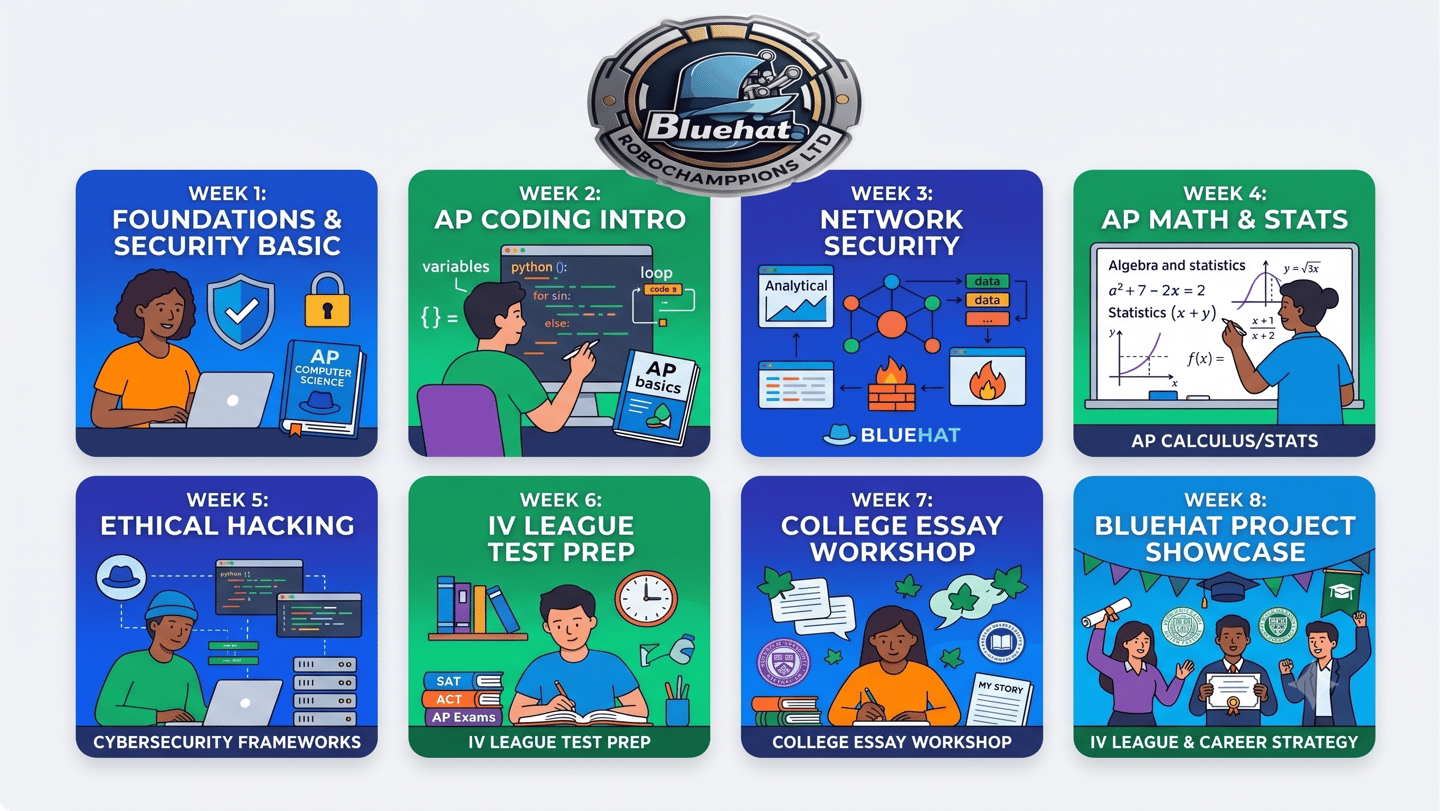
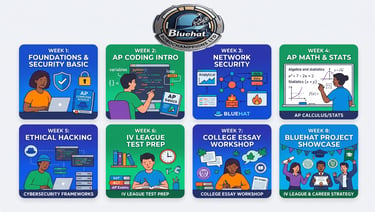
DETAILED CURRICULAM
You didn’t come this far to stop
Month 1: AP Math & Supercar Physics
Grounding mathematics in high-performance mechanics.
Week 1 (Clases 1 & 2): Newton's Laws & Drivetrains. Introduction to mechanical force and weight distribution.
Week 2 (Classes 3 & 4): The Supercar Physics Lab. Calculating gear ratios and applied torque ($\tau = \mathbf{r} \times \mathbf{F}$) required to maximize acceleration, using a Lamborghini's specs as the baseline.
Week 3 (Classes 5 & 6): 2D to 3D Geometry. Translating 2D mathematical concepts into physical 3D space.
Week 4 (Classes 7 & 8): Articulation Math. Calculating precise mathematical vertices and angles required for robotic limb movement.
Month 2: Data Structures & Python Architecture
Building the logical backbone for competitive coding.
Week 5 (Classes 9 & 10): Python Logic Over Syntax. Setting up the Python environment. Moving past basic print statements to understand variables, loops, and clean architecture.
Week 6 (Classes 11 & 12): Advanced Data Structures. Mastering arrays, matrices, and an introduction to Big-O notation for algorithm efficiency.
Week 7 (Classes 13 & 14): Grid Mathematics. Understanding how autonomous vehicles read and interpret 2D maps and grids.
Week 8 (Classes 15 & 16): Pathfinding Algorithms. Writing a simplified A* (A-Star) search algorithm in pure Python to navigate a maze.
Month 3: Humanoid Kinematics
Applying code to the Hiwonder TonyPi Pro bipedal hardware.
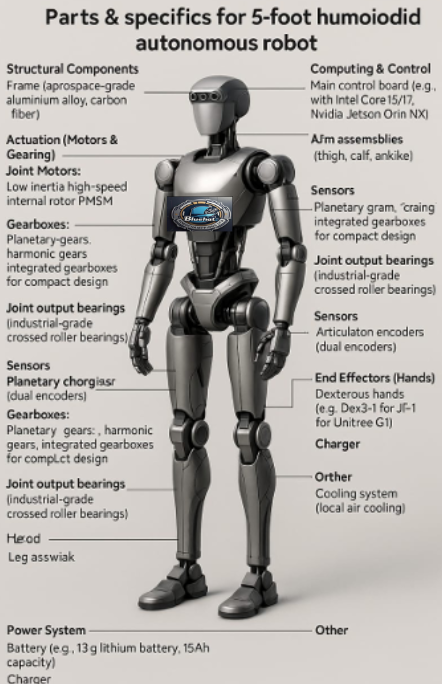
Week 9 (Classes 17 & 18): Hardware Architecture. Assembling and studying the mechanics of bipedal robots, focusing on movable hands and complex neck joints.
Week 10 (Classes 19 & 20): Servo Calibration Scripts. Writing pure Python scripts to calibrate individual servos and establish a center of gravity.
Week 11 (Classes 21 & 22): Fluid Motion. Programming synchronized timing loops to execute a stable, human-like walking gait without the robot falling over.
Week 12 (Classes 23 & 24): Industry Troubleshooting. Real-world debugging. Resolving Qt interface errors and stabilizing VNC remote desktop connections to the onboard computer.
Month 4: The AI Brain & Vision
Giving the hardware eyes and classification abilities.
Week 13 (Classes 25 & 26): OpenCV Fundamentals. Accessing the robot's HD camera via Python, understanding frame rates, and pixel arrays.
Week 14 (Classes 27 & 28): Tracking & Depth. Programming the system to track specific color profiles and measure approximate depth and distance.
Week 15 (Classes 29 & 30): Intro to Machine Learning. The absolute basics of neural networks and setting up a PyTorch environment.
Week 16 (Classes 31 & 32): Real-Time Classification. Training a lightweight Convolutional Neural Network (CNN) to recognize and classify physical blocks or objects in real-time.
Month 5: In Silico Medicine Basics
Bridging artificial intelligence with the pharmaceutical industry.
Week 17 (Classes 33 & 34): Digital Chemistry. Teaching students how AI reads chemical data using SMILES strings.
Week 18 (Classes 35 & 36): Data Parsing. Using Python to parse and categorize different chemical structures based on their digital representations.
Week 19 (Classes 37 & 38): Bio-Tech Integration. Utilizing tools like RDKit to handle chemical informatics.
Week 20 (Classes 39 & 40): Visualization. Using MolView to visualize and manipulate the 3D structures of common molecules like ibuprofen.
Month 6: Automated Medical Sorting
The physical pipeline challenge.
Week 21 (Classes 41 & 42): Molecular Docking Intro. Exploring how proteins and molecules interact using basic ChimeraX concepts.
Week 22 (Classes 43 & 44): System Integration. Tying the PyTorch vision models directly to the hardware's robotic arm controls.
Week 23 (Classes 45 & 46): The Sorting Logic. Writing the loops that dictate: "If Camera sees Molecule A, move Arm to Bin 1."
Week 24 (Classes 47 & 48): The AI Pharmacy Challenge. A full-scale simulation where the robot autonomously identifies, classifies, and physically sorts complex simulated chemical structures on a testing mat.
Month 7: Agentic Logic & RAG
Teaching the robot to retrieve information and make decisions.
Week 25 (Classes 49 & 50): Information Retrieval. How AI systems query external databases instead of relying solely on training data.
Week 26 (Classes 51 & 52): Database Setup. Building a lightweight JSON-based medical database for the robot to reference.
Week 27 (Classes 53 & 54): RAG Pipeline Construction. Building a basic Retrieval-Augmented Generation pipeline in Python.
Week 28 (Classes 55 & 56): The Autonomous Assistant. Programming the robot to visually scan an item, query the database, and accurately answer spoken questions about that specific item.
Month 8: Secure APIs & The LA Capstone
If it connects to the internet, it must be secure.
Week 29 (Classes 57 & 58): Network Security 101. Understanding IP addresses, ports, and how remote code execution works (and how to stop it).
Week 30 (Classes 59 & 60): FastAPI Backend. Building secure backend endpoints to control the robot over a local network.
Week 31 (Classes 61 & 62): Encrypted Communications. Setting up a system to remotely trigger the robot's actions securely via an external app (like WhatsApp), ensuring the signal cannot be hijacked.
Week 32 (Classes 63 & 64): The Defense Protocol (Capstone). The final live simulation for LA parents. Students demonstrate their automated pharmacy pipeline and must actively patch an intentional vulnerability in their code in real-time.
WMonth 9: The Ivy League Booster & Future Tech (Free Reward Month)
Exclusive 4-Week Capstone Extension for Graduating "Bluehat Scholars"
Week 1 (Classes 65 & 66): The Cutting Edge – Agentic AI
Moving beyond chatbots to AI that takes action.
Concept: Introduction to Agentic Workflows. Students learn how AI can act as a reasoning engine rather than just a text generator.
Application: Students build a simple Python-based "Agent" that can access tools. For example, an agent that can autonomously search the web for chemical properties, do the math, and send instructions to their robotic arm—without human intervention.
Ivy League Edge: Demonstrating an understanding of Agentic AI puts a high schooler on par with current university-level computer science research.
Week 2 (Classes 67 & 68): The Creative Edge – AI Video Generation
Creating high-end portfolio presentations.
Concept: The architecture behind text-to-video AI (like Sora, Runway, or open-source diffusion models). How does AI generate temporal physics and pixels?
Application: Students learn advanced prompt engineering to generate a professional, AI-assisted video showcasing their 8-month AI Pharmacy Capstone project.
Ivy League Edge: Colleges don’t just want to see code; they want to see the product. Students use AI video tools to create a Silicon Valley-style pitch video of their robotic build for their university portfolio.
Week 3 (Classes 69 & 70): AP Computer Science Blitz & Revision
Translating 8 months of Python and hardware into AP Exam success.
Concept: Heavy revision of Data Structures, Algorithms (DSA), loops, arrays, and matrices. We bridge their Python knowledge into the logic required for the AP Computer Science A (Java) and AP Computer Science Principles exams.
Application: Whiteboard coding and algorithmic tracing. Students practice breaking down complex sorting algorithms (like the ones they used for the pharmacy robot) into exam-ready pseudocode.
Ivy League Edge: Direct, targeted test prep. We train them to beat the clock on multiple-choice logic questions and free-response coding sections.
Week 4 (Classes 71 & 72): The Bluehat Ivy Benchmark Test & Portfolio Polish
The final gauntlet and packaging their genius.
The Benchmark Test: A grueling, 2-hour simulated entrance exam covering applied physics, advanced Python logic, and basic AI architecture to see exactly where they stand nationally.
Portfolio Packaging: We teach students how to upload their code to GitHub, write a professional README file, and link their AI Video pitch.
The Deliverable: Every student graduates with a live, shareable digital portfolio link containing their AI Pharmacy robot code and video—ready to be pasted directly into the "Extracurriculars" section of the Common App for Ivy League admissions.

The Bluehat Loyalty Guarantee"
We don't just teach your child and leave them to figure out the exams on their own. Students who successfully complete our 8-Month Pre-College AI Accelerator are automatically enrolled in our exclusive Month 9 Ivy Booster—absolutely FREE.
In this final 4-week sprint, we introduce them to tomorrow's tech—Agentic AI and AI Video Generation—while running a rigorous AP Computer Science revision blitz. We finish by administering the Bluehat Benchmark Test and packaging their 8 months of robotics code into a polished, professional GitHub portfolio, ready to be sent directly to Stanford, MIT, or the Ivy League of their choice.


📞 Contact Information
📧 Email: ceo@bluehatrobochampions.com
📱 Phone: +91 8079071338
💼 About US
Parent Company : Jaipur Eduventures
Registration Number :UDYAM-RJ-17 -0018482
GSTIN : 08AEXPC2860D1ZG

